
Product updates
50skills Product News

Add Supporting Text to Form Fields

Shared by Georg
•
You can now add optional supporting text to form fields, giving you a way to provide context, instructions, or examples to your users. This explanatory text appears directly below the field label and above the input.

- Supporting text is available for all input fields (Short text, Long text, Number, Date, File upload, Phone number, Email address) & selection fields (Multiple choice, Single choice, Dropdown)
- A new "Supporting text" input appears in the form builder's field configuration, positioned between Label and Placeholder text
- Supporting text is saved with your form and renders in both external forms and the Send form journey action
- Leave supporting text empty to show nothing—spacing and layout remain unchanged
We'd love to hear how you use this feature to improve your forms.

Filter any column in two clicks
Shared by Georg
•
Filtering a table just got a lot faster.

Every column header menu now has a Filter by this field option. Click it and a filter popover opens right at the column you're on, pre-targeted at that field. Two clicks from "I want to filter this column" to a set value, no trip up to the toolbar Filter button.
Why you'll like it
- Two clicks instead of four. Open the column menu → Filter by this field → set your value. Done.
- Pre-targeted. The popover already knows which field you're filtering, so you can't pick the wrong one by mistake.
- Works everywhere. Every table column header in the product gets the shortcut — same behavior, same place.
- Stacks with existing filters. The new filter is added to whatever you already have set; nothing is reset.
Open any table, click the ⋯ on a column header, and look for Filter by this field.

New trigger, meet Mailhook!
Shared by Georg
•
You can now kick off a journey workflow just by sending an email to a specific e-mail address.

Add a Mailhook trigger to any journey and you get a unique trigger email address. Forward (or have a system send) an email to it, and Mailhook uses AI to pull the details you care about out of the email body, full name, email, plus any traveller or journey fields you define and starts the journey for that traveller automatically.

What you can do
- Trigger by email. Each Mailhook has its own dedicated address — copy it once and you're done.
- AI extracts the fields. Full Name and Email are picked up out of the box. Add more traveller or journey fields and write a short instruction telling the AI what to look for.
- Test & Configure. Paste a sample email and Mailhook generates the extraction instructions for you — no prompt engineering required.
- Conditions, duplicates, auto-start. Same options you're used to on other triggers.
Open any journey, add a trigger, pick Mailhook, and try it on a sample email, the Test / Configure button does most of the work.

See exactly what happened on every action, Activity timeline
Shared by Georg
•
Ever wondered when an action ran, who edited it, or why it was skipped? You don't have to anymore.

Every action in a traveler's journey now has an Activity tab that shows a chronological timeline of everything that's happened — automatic events from the system and manual changes from your team — with who did it and when.
What gets logged
- Action started / completed — when the system runs an action
- Manually started — someone kicked it off by hand
- Skipped / unskipped — and who did it
- Condition bypassed — a condition was overridden
- Action edited — configuration changed mid-flight
- Action reset — back to the drawing board
- Action error — what failed
- Reminder sent (Send form actions)
Open any action in a traveller's journey, switch to the Activity tab, and you've got the full story at a glance, no more digging through logs or guessing who clicked what.

Feature
SSO User Identity Now Pre-fills Portal Forms
Shared by Georg
•
When your users sign in via Azure SSO to access portal forms, their name and email can now be automatically pre-filled into submitter fields. This reduces friction, improves data accuracy, and makes form submission faster.

- Enable "Use signed-in user identity in forms" in the portal Security tab (Azure settings) to set a portal-wide default for how pre-filled fields behave
- Choose whether pre-filled fields are locked (read-only), editable, or not used at all—and customize per form if needed
- Individual forms can override the portal default with their own "Portal identity for submitter fields" setting
- This feature only applies when the portal is secured with Azure SSO login
Let us know how this works for your team, or reach out if you have questions about configuring the feature.

Improvement
New Export Options for Traveller Data
Shared by Georg
•
We've expanded the ways you can export and work with your Traveller Data.

You now have two additional export options alongside the existing CSV format, giving you more flexibility to analyze and share your data.
- Export as XLS file — downloads your data in Excel format with the same structure and applied filters as your CSV export
- Open in Google Sheets — creates a new Google Sheet with your Traveller Data and opens it automatically in a new tab, ready to collaborate
Both options respect your current filters and maintain the same column structure as before. Let us know how these new export options work for you.

Journeys
Feature
User Roles
Shared by Georg
•
You can now control who can submit external forms and when they close. Journeys uses company-level roles to control who can access settings, navigation areas, and administrative actions across your company account.
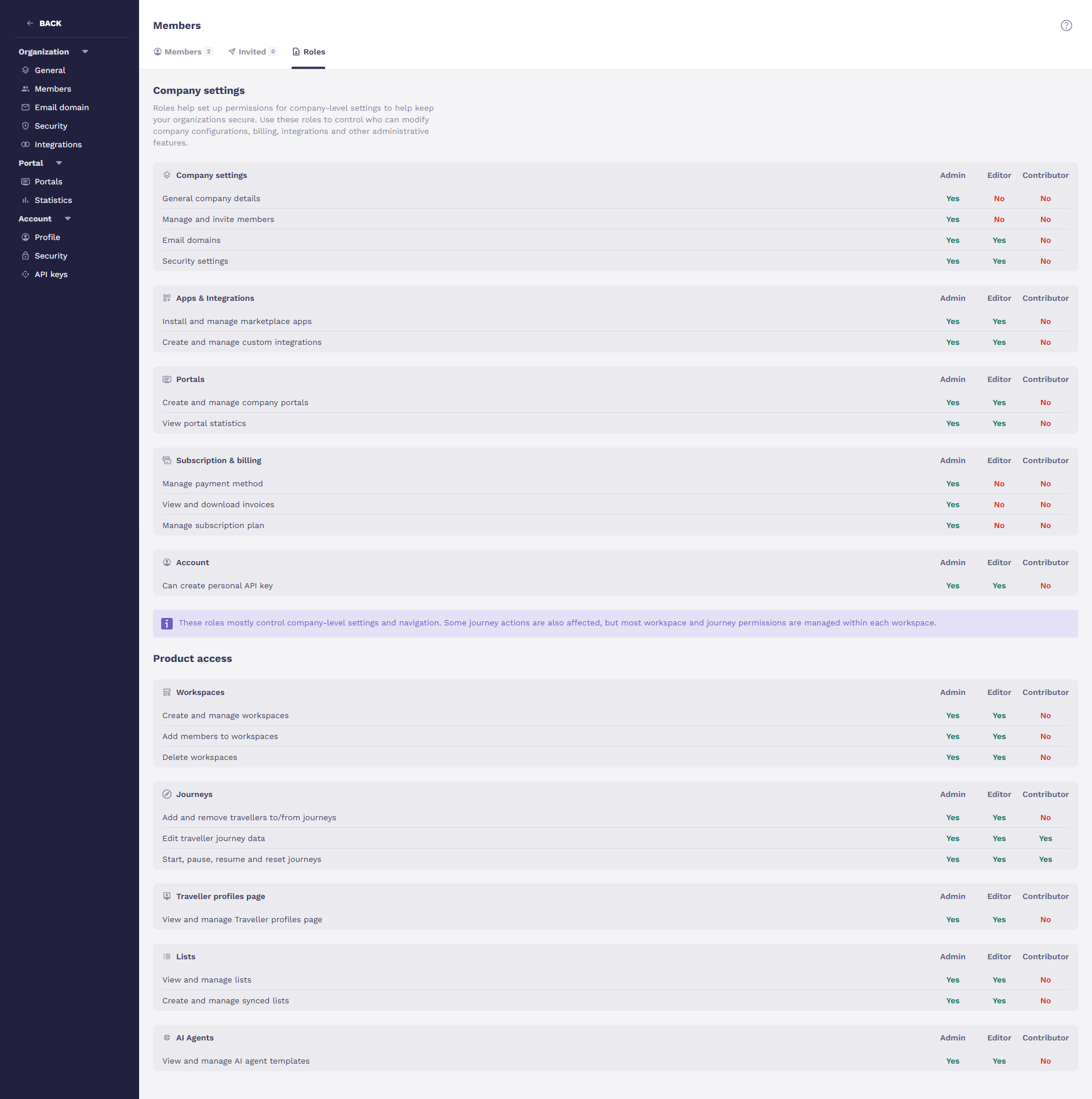
These roles ensure that users only see and interact with the parts of the platform they have permission to use.
There are three roles:
Admin -> Full access to everything, including billing, security settings, and member management
Editor -> Can build and manage journeys and workspaces, but can't touch sensitive company-level settings like billing or security
Contributor -> A focused role for people who need to work within journeys but don't need access to configuration or admin features
Roles are assigned when inviting a new member or by editing an existing one from the Members page.
Navigation automatically adjusts based on the role, contributors and editors simply won't see sections they don't have access to.
There's also a safety guard built in: you can't demote the last Admin in your organization.

Journeys
Feature
Access & Scheduling for External Forms
Shared by Georg
•
You can now control who can submit external forms and when they close.
Use this to:
- Open forms only during specific enrollment periods
- Automatically close event registrations at a set time
- Limit submissions per traveller or overall capacity
- Display a custom message when the form is closed

Under the External form settings you'll find a new Access & Scheduling section with four options:
Close date -> Set a specific date and time when the form stops accepting submissions
One submission per traveller -> Prevent duplicate submissions by restricting to one per email address
Total response limit -> Cap the total number of submissions allowed
Custom closed message -> Write a message travellers will see once the form is no longer accepting responses

Journeys
Feature
Navigator — New Tools
Shared by Georg
•
Our AI Navigator has a set of new capabilities.
Portal link — Navigator can now look up and share the portal link where an external form lives, so you don't have to go find it yourself.
Example

Update journey title -> You can now ask Navigator to rename the journey directly from the chat.
Image previews -> When you upload an image in the Navigator chat (for example, to reference a design or screenshot), it now shows a preview with the file name instead of a blank placeholder.
Document template previews -> When Navigator is picking a document template to use in a step, you can now preview the template inline before it gets added to the journey.

Journeys
Feature
OpenAPI Importer for Integrations
Shared by Georg
•
Setting up integrations just got a lot faster. You can now import an OpenAPI (Swagger) specification directly, paste the URL or upload the file, and Journeys will automatically create your integration endpoints from it.

For each endpoint it finds, the importer will:
- Detect the authentication method required (API key, Bearer token, Basic auth, etc.)
- Generate request and response fields with variable suggestions already mapped
- Extract the server URL and handle path parameters automatically